German Research Allowance Act (FZulG): What It Means for Zefyron
Executive Summary
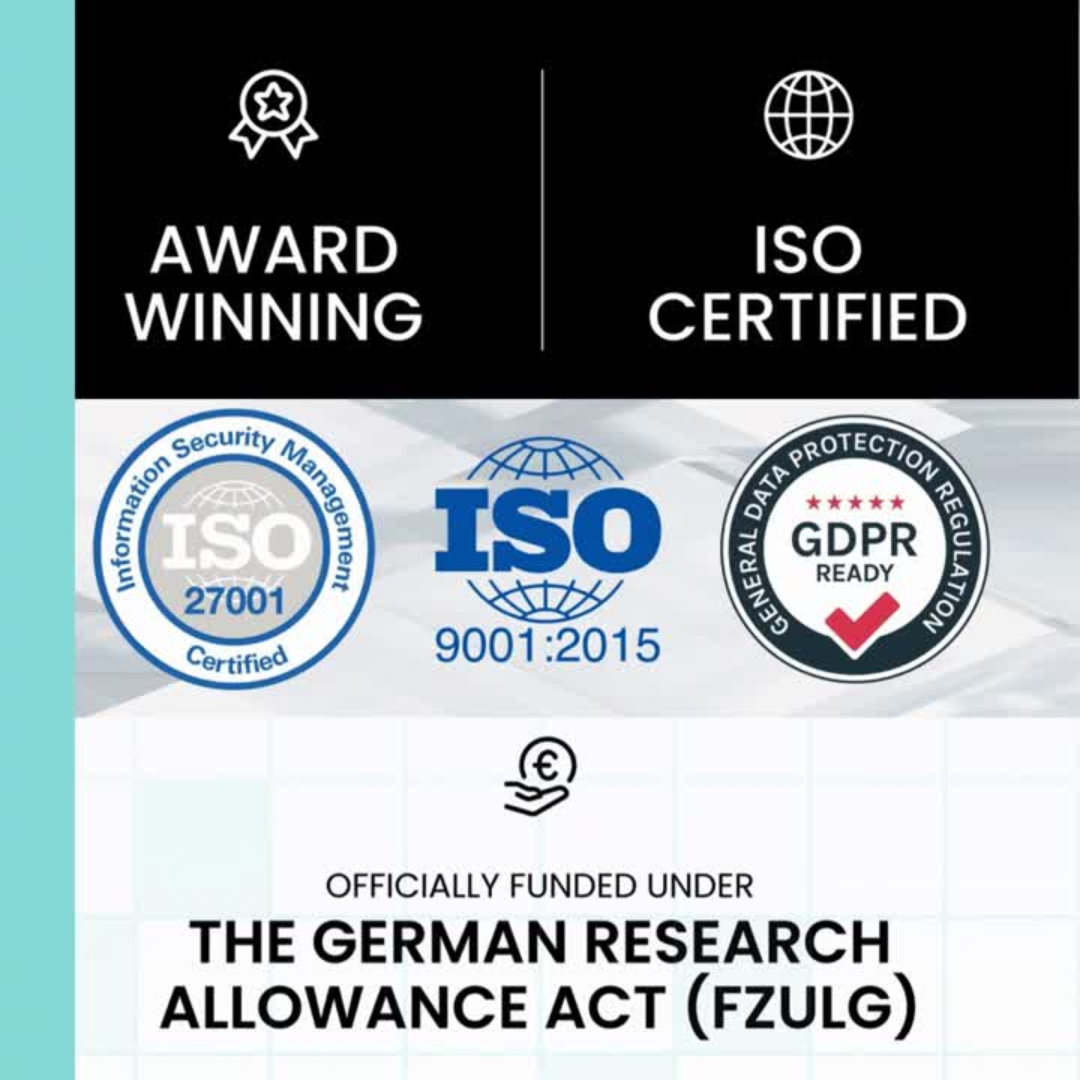
Recognition signals progress, but formal validation defines credibility. Zefyron’s approval under the German Research Allowance Act (Forschungszulage – FZulG) represents more than a milestone. It is confirmation that the platform’s work meets the criteria of genuine research and development under a rigorous regulatory framework. In a market where “AI” is often positioned as a feature, this distinction matters. It reflects that Zefyron is not building surface-level automation, but underlying infrastructure for how venture capital ecosystems operate. The approval reinforces a broader positioning: AI as an operating layer across the full venture workflow, from sourcing to execution.
Introduction
The German Research Allowance Act (FZulG) is designed to support innovation by recognizing and incentivizing qualifying R&D activities. Approval under this framework requires technical substance, methodological rigor, and demonstrable research intent. For companies operating in applied AI and platform infrastructure, such recognition distinguishes between incremental software development and true research-driven innovation. Zefyron’s approval reflects that its platform architecture, AI-driven workflows, and system design meet these criteria. It positions the company within a category of builders focused on long-term technological foundations rather than short-term feature expansion.
What Zefyron Is Building
Zefyron operates as an AI-powered operating partner for the venture ecosystem. The platform integrates multiple stakeholders—investors, startups, corporates, and academia—into a single coordinated workflow. Rather than acting as a matching layer, it structures the entire lifecycle of venture interaction.
- Investors access validated deal flow, structured pipelines, and data-driven decision tools within secure environments.
- Startups improve funding outcomes through AI-supported preparation, positioning, and targeted investor alignment.
- Corporates identify and manage innovation partnerships with scalable, structured processes.
- Academia transforms research into ventures and builds connected innovation ecosystems.
The core objective is not visibility, but decision quality and execution efficiency across the entire capital allocation process.
Why FZulG Approval Matters
FZulG approval is not a branding exercise. It is a formal signal that the underlying work involves genuine research complexity. For Zefyron, this reinforces several key points:
- The platform is built on original R&D, not repackaged tooling.
- AI is applied as an infrastructure layer, not a superficial feature.
- The system addresses structural inefficiencies in venture workflows.
- Long-term innovation is prioritized over short-term optimization.
In a market saturated with AI narratives, formal validation creates differentiation through substance rather than messaging.
Implications for the Venture Ecosystem
The venture ecosystem remains fragmented across sourcing, evaluation, and execution. Data is often inconsistent, processes are manual, and decision-making lacks structure. Platforms that unify these layers can improve capital allocation efficiency and reduce friction across stakeholders. Zefyron’s approach suggests a shift toward integrated systems where intelligence is embedded throughout the workflow. This has implications not only for investors and startups, but also for corporates and research institutions seeking structured pathways to innovation. As capital becomes more selective, infrastructure that improves decision quality may become a critical advantage.
Implications for Investors and Partners
For investors and ecosystem partners, FZulG approval provides an additional signal of technical credibility. It indicates that the platform’s development is grounded in research rather than incremental product iteration. This can influence partnership decisions, particularly in environments where trust and reliability are essential. Platforms that combine research-backed development with practical execution capabilities are better positioned to support long-term ecosystem growth.
Risks, Limitations, or Open Questions
While regulatory approval validates the research foundation, execution at scale remains the defining challenge. Integrating multiple stakeholders into a single workflow requires continuous refinement of data models, user experience, and interoperability. Adoption depends on whether the platform can deliver measurable improvements in efficiency and outcomes. Additionally, maintaining research depth while scaling commercially requires sustained investment and alignment between technical and business priorities.
Outlook
The recognition under FZulG reinforces a broader trend: infrastructure-level innovation is becoming central to the evolution of the venture ecosystem. As AI expands the range of possibilities, the value shifts toward systems that can structure and operationalize that intelligence. Zefyron’s approach positions it within this transition, focusing on long-term efficiency and improved capital allocation. The next phase will be defined by how effectively these systems translate research into measurable ecosystem impact.
Frequently Asked Questions
Q1: What is the German Research Allowance Act (FZulG)?
It is a government framework that recognizes and supports qualifying research and development activities, requiring technical rigor and demonstrable innovation.
Q2: Why is FZulG approval significant for Zefyron?
It confirms that Zefyron’s work qualifies as genuine R&D, reinforcing its position as a technology-driven infrastructure platform rather than a standard software product.
Q3: How does Zefyron differ from typical platforms?
Instead of focusing only on introductions, it integrates data, AI-driven analysis, and execution workflows into a single system for the venture ecosystem.
Summary
Zefyron’s approval under the German Research Allowance Act represents formal validation of its research-driven approach to building AI-powered venture infrastructure. By integrating stakeholders across the venture lifecycle and embedding intelligence into every step, the platform aims to improve decision quality and capital allocation efficiency. The recognition underscores a broader principle: meaningful innovation in complex ecosystems requires real research, structured systems, and long-term execution discipline.