
A practical guide to finding the right investors, creating relevant outreach, and building meaningful fundraising conversations.
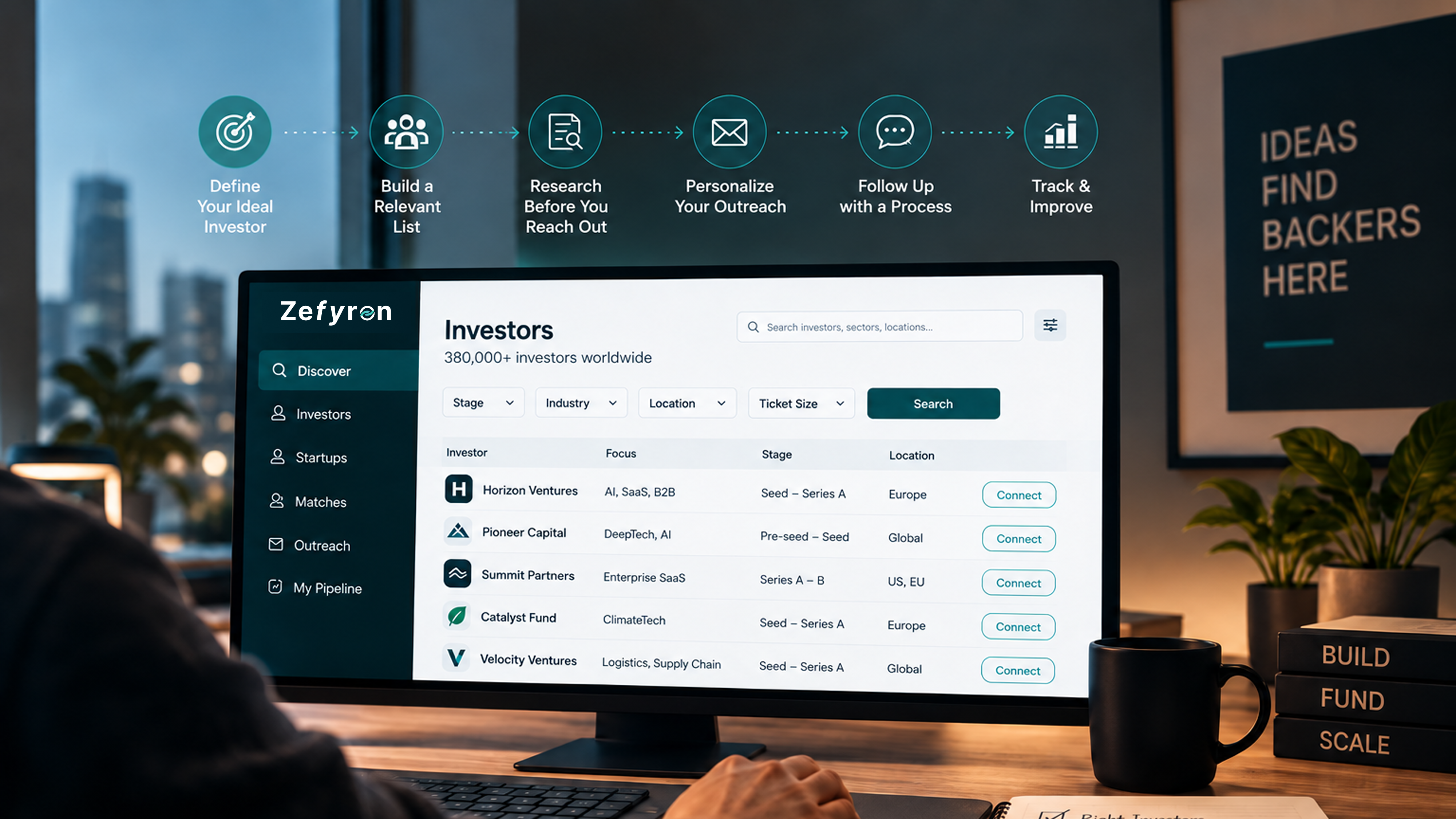
Fundraising outreach isn't simply about sending as many investor emails as possible.
Before you hit send, you need to know:
A list of hundreds of investors means little if only a few fit your industry, stage, geography or funding requirements.
The objective isn't more contacts. It's more relevant conversations.
Start by creating a clear investor profile. Consider:
For example, a Seed-stage B2B SaaS startup raising €2M shouldn't approach investors simply because they invest in technology.
The better question is: have they invested in businesses like ours, at a stage and ticket size that fits our raise?
That's where investor fit starts.
Once you know your ideal investor profile, build your target list around it. Don't just collect names.
For every potential investor, try to understand:
| Investor factor | Why it matters |
|---|---|
| Investment stage | Does it match your current round? |
| Sector | Do they understand your market? |
| Geography | Do they invest in your region? |
| Ticket size | Does it fit your funding requirement? |
| Portfolio | Have they backed similar companies? |
| Investment thesis | Does your startup fit their focus? |
| Relevant contact | Who should you approach? |
This turns an investor database into a fundraising pipeline.
This is also where investor intelligence can make a difference. Zefyron's 380K+ investor database gives startups a broad pool of investors to explore and identify potential matches based on their fundraising requirements.
Finding an investor is only the beginning. Before contacting them, look at their recent investments, portfolio, investment thesis and areas of interest.
Suppose you're building an AI-powered logistics platform. Instead of targeting every investor who mentions “AI,” you could look for investors with experience across:
AI + Logistics + B2B + Early Stage
Now your outreach has a reason behind it. You're not contacting an investor because they're on a list. You're contacting them because there is a potential fit.
One of the biggest problems with investor outreach is generic messaging.
Hi [Name],
We're an AI startup revolutionizing logistics. We're currently raising €2M and would love to connect and discuss our opportunity.
It could be sent to almost anyone.
Hi [Name],
I noticed your investments in early-stage B2B technology and logistics. We're building [Company], an AI platform helping logistics companies solve [specific problem]. We're currently raising €2M and thought the opportunity could align with your investment focus.
The difference isn't length. It's relevance.
Your first message should quickly establish: why this investor? Why this startup? Why now?
Personalization doesn't mean writing a completely different email for every investor. One relevant detail can be enough:
The goal isn't to sound overly familiar. It's to show: “I know why I'm contacting you.”
That makes the outreach feel researched rather than mass-sent.
Sending one email and waiting isn't a fundraising strategy. A structured process could look like:
Initial outreach → Follow-up → Conversation → Further information → Continued engagement
The exact timing will depend on the investor and situation, but consistency matters.
You should also track what happens after each outreach:
Investors contacted → Responses → Meetings → Follow-ups → Active conversations
This helps you understand whether the challenge is targeting, messaging, positioning or follow-up.
Fundraising outreach should generate useful data. For example, imagine:
200 investors contacted → 25 responses → 10 meetings → 4 follow-up conversations
That tells you much more than simply saying: “We contacted 200 investors.”
If responses are low, your targeting or messaging may need attention. If responses are strong but meetings are low, investor fit or positioning may need to be reviewed.
The numbers help you improve the process instead of simply increasing outreach volume.
Finding the right investors can take significant time—not because there aren't enough investors, but because there are too many possibilities to evaluate. Zefyron helps startups bring more structure to that process.
With access to a 380K+ investor database, startups can explore a broad network of potential investors and narrow their focus based on factors relevant to their raise.
Investor Discovery & Matching helps identify potential investors that align with the startup's requirements.
Smart Contact Intelligence provides relevant investor and contact information to support more informed outreach.
And through Investor Outreach Service, Zefyron supports startups in the outreach process when they are actively raising capital.
The value isn't simply having access to a large investor database. It's turning a large pool of investors into a more focused fundraising pipeline.
Discover. Match. Connect.