
AI Penetration in German Fintech Industry
FinTech is about using technology to make financial activities more accessible, faster, and more convenient. FinTech companies often leverage mobile apps, online platforms, data analytics, and artificial intelligence to deliver financial services more efficiently and effectively. These innovations aim to streamline traditional financial processes, enhance customer experience, and enable individuals and businesses to manage their finances in a more user-friendly and accessible way.
How is the FinTech industry segmented?
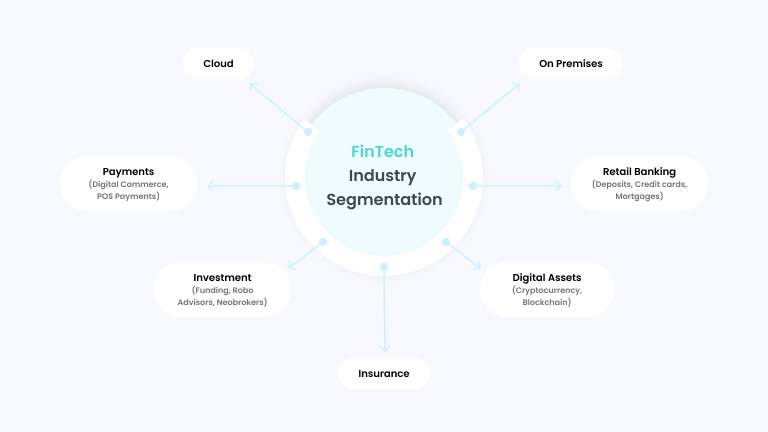
FinTechs have two categories: cloud-based or on-premises. The services within the FinTech industry have five key segments: payments (including digital commerce and mobile POS payments), investment (involving Funding, robo-advisors, and no brokers), retail banking (covering deposits, credit cards, and mortgages), insurance, and digital assets (such as cryptocurrency and blockchain).
What is the market size of Germany’s FinTech industry?
Germany has become a prominent hub for FinTech investments in Europe, thanks to its status as the largest economy on the continent and its supportive government policies. The country boasts a substantial number of small and medium-sized enterprises, known as the "Mittelstand," totalling around 3.5 million. Germany has over 1,500 banks, showcasing its robust domestic financial sector.
Within Germany, different cities have specialized focuses on the FinTech industry. Frankfurt, for instance, is a hub for business-to-business (B2B) FinTech companies, while Berlin, with its roots in e-commerce, primarily emphasizes business-to-consumer (B2C) FinTech offerings.
Federal Financial Supervisory Authority (BaFin)strengthened Germany's financial landscape, which ranks among Europe's most prominent monetary supervisory authorities. BaFin is pivotal in ensuring the stability of the continent's most significant financial market by serving as an integrated financial supervisor, overseeing the banking, securities, and insurance sectors.
According to Informa, Germany's FinTech market was valued at USD 10.92 billion in 2022, reaching USD 71.15 billion by 2030, with a compound annual growth rate (CAGR) of 26.4% from 2023 to 2030. Statista states that the most significant market in Germany will be Digital Investment, with a total transaction value of US$5.16 billion in 2023. The projected average transaction value per user in the Digital Investment market in 2023 is US$565.20. In 2021, the FinTech sector alone attracted over EUR 3.76 billion in investments. GTAI reports that Germany's banking sector secured the most FinTech investment in 2021, raising EUR 1.27 billion in investment capital through 22 rounds. Digital commerce represents the largest segment, with a total transaction value of EUR 4.91 billion in 2022 and is forecasted to increase to EUR 7.23 billion in 2026.
How has AI changed the Fintech market in recent years?
In 2017, Germany started its Digital. Hub initiative (de hub) to promote digital transformation. With over 900 FinTech companies actively operating in various sectors like PropTech, financing, InsurTech, investment, blockchain, and accounting, the country's FinTech ecosystem continues to expand.
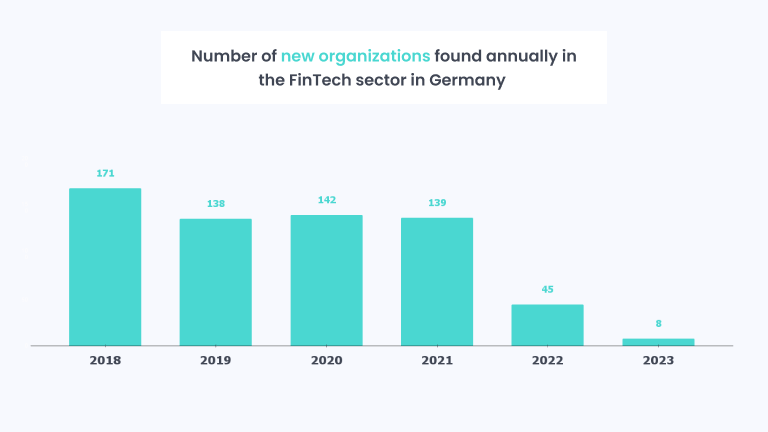
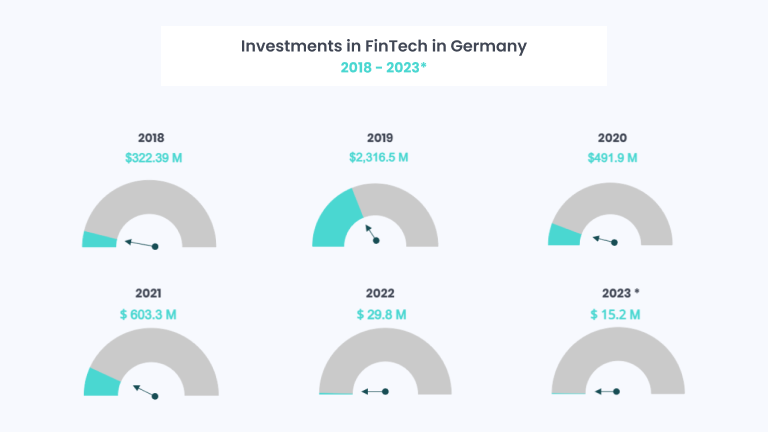
Based on data, the number of newly founded organizations over the past five years (2017-2022) is as follows: In 2018, there were 171 new organizations; in 2019, there were 138; in 2020, there were 142; in 2021, there were 139; and in 2022, there were 45. As of now, the current year has recorded eight newly founded startups. In 2019, there was an excellent investment of 2316.5 million, the highest in recent years. One possible reason for this increase could be the pandemic, where the necessity for digital solutions led to a demand for new digital innovations. Over and over, The land of bureaucracy is gradually embracing digitalization. Despite these challenges, The number of angel investors and venture capitalists in Germany has been increasing in recent years, providing much-needed support to startups.
Here are a few examples of players in Germany's FinTech industry and how they incorporate AI into their business operations:
(No specific ranking involved)

Origin: Berlin, Berlin, Germany
Founders: Eric Pfarl, Harald Gölles, Martin Micko, Sofie Quidenus-Wahlforss, Stephan Dorfmeister
Establishment year: 2015
Total Funding (in USD): $ 58.36 M
Investor/s: European Innovation Council, Plug and Play, Target Global, Anthemis Group, MMC Ventures
How does Omni:us employ artificial intelligence (AI) within their business operations?
Omni:us is an AI-powered solution provider for the insurance industry. They utilize AI to automate tasks, identify patterns in claims data, and provide insights to insurers. Their Digital Claims Adjuster platform automates the claims handling process and offers decision-making capabilities based on AI analysis. Omni:us also provides pre-built workflows for specific tasks and connectors to integrate with other systems, enabling insurers to streamline processes and improve data accuracy.
Origin: Berlin, Berlin, Germany
Founders: Benjamin Schickert, Frane Bandov, Mark Hartmann, Nikolaus Hilgenfeldt, Tim von Hörsten
Establishment year: 2018
Total Funding (in USD): $ 44.38 M
Investor/s: Mountain Partners, Xploration Capital, Fasanara Capital, Tomahawk.VC, Dr. Cornelius Boersch
How does Myos employ artificial intelligence (AI) within its business operations?
Myos utilizes AI to automate asset-based financing for e-commerce sellers. Myos uses a disruptive, AI-based risk-scoring model as the cornerstone. Their AI-powered algorithm analyzes inventory, sales data, and other factors to determine eligible financing amounts, replacing extensive documentation. Using AI, Myos ensures sellers receive necessary financing while reducing default risk and keeping costs low. The algorithm also monitors repayments, enhancing accuracy and efficiency.

Origin: Berlin, Berlin, Germany
Founders: Artur Hasselbach, Bastian Schmidtke, Jakob Schreyer, Patrick Brienen-Lucius
Establishment year: 2011
Total Funding (in USD): $ 38.79
Investor/s: European Commission, Digital+ Partners, Concardis, LeadX Capital Partners, METRO GROUP
How does Orderbird employ artificial intelligence (AI) within its business operations?
Orderbird provides POS system services for the hospitality industry. Orderbird utilizes AI to enhance the customer experience and operational efficiency. Orderbird enables users to conveniently access accounting services, download invoices, and view analyses and reports of business figures anytime and from any location. Additionally, the system facilitates cashless and contactless payments, making accounting simpler by automatically recording all transactions in the comprehensive Orderbird PRO POS system. Through predictive analytics, it forecasts customer demand to optimize staffing and prevent food shortages or overstaffing. They also handle customer inquiries, orders, and recommendations, freeing up staff for other tasks. AI-based table management ensures efficient seating based on party size, wait time, etc.

Origin: Hamburg, Hamburg, Germany
Founders: Andreas Santoro, Dennis Konrad, Konstantin Loebner, Maximilian Graf Lambsdorff, Mehdi Afridi
Establishment year: 2019
Total Funding (in USD): $32.13 M
Investor/s: Insight Partners, JALE Beteiligungs GmbH, Aurelia Ventures, Mountain Partners, Kai Hansen
How does ExpressSteuer employ artificial intelligence (AI) within its business operations?
ExpressSteuer utilizes AI to automate tax filing by gathering and processing information from various sources. AI calculates the base value of your expected reimbursement based on your entries and shows you further information. Their AI identifies potential deductions and credits for users, generates accurate tax forms, and provides straightforward answers to tax-related inquiries. By leveraging AI, ExpressSteuer streamlines and improves the efficiency of tax filing, making it more convenient and cost-effective for users.

Origin: Berlin, Berlin, Germany
Founders: Christian Ritosek, Christopher Becker, Garik Suess
Establishment year: 2015
Total Funding (in USD): $31.20 M
Investor/s: Speedinvest, Lightspeed Venture Partners, Viola Ventures, Fly Ventures, 42CAP
How does Candis employ artificial intelligence (AI) within its business operations?
Candis is an AI-powered financial planning platform that automates financial tracking, identifies potential savings, and generates personalized financial plans. By connecting with users' bank accounts and other financial institutions, Candis analyzes income, expenses, and investments to create customized programs. Through AI, Candis helps users make informed financial decisions and reach their goals efficiently and affordably. Whether it's automating financial tracking or generating personalized plans, Candis offers a comprehensive solution for better financial management.

Origin: Frankfurt, Hessen, Germany
Founders: Alexander Michel, Benjamin Michel
Establishment year: 2015
Total Funding (in USD): $ 30.17 M
Investor/s: Deutsche Bank, Redstone, seed + speed Ventures, PayPal Ventures, SCOR Ventures
How does Finanzguru employ artificial intelligence (AI) within its business operations?
FinanzGuru harnesses artificial intelligence (AI) to deliver personalized financial advice to customers based on their specific needs and goals. They calculate users' free disposable income in real-time based on users' income and expenses. Their AI-powered platform provides insights on saving, budgeting, and retirement investment, tailoring recommendations to individual requirements. Additionally, the platform aids in fraud detection by analyzing users' financial transactions for signs of fraudulent activity.
Origin: Munich, Bayern, Germany
Founders: Tobias Schweiger, Wolfgang Berner
Establishment year: 2018
Total Funding (in USD): $ 27 M
Investor/s: Picus Capital, Sands Capital Ventures, BlackFin Capital Partners, DN Capital, Coalition Capital
How does Hawk.ai employ artificial intelligence (AI) within its business operations?
Hawk AI is an advanced platform utilizing AI technologies such as natural language processing, machine learning, and behavioural analytics to combat money laundering and fraud. The platform automates transaction monitoring, assigns risk scores to transactions and customers, and aids in case management for AML and fraud investigations. By leveraging AI, Hawk AI empowers financial institutions to comply with regulations, enhance efficiency, and mitigate risks associated with financial crime. The platform's AI capabilities enable it to understand transaction content, learn from data, and identify behavioural patterns indicative of suspicious activity. Hawk AI is a valuable solution for financial institutions seeking effective AML and fraud prevention measures.
Origin: Berlin, Berlin, Germany
Founders: Chen Zamir, Max Laemmle
Establishment year: 2014
Total Funding (in USD): $ 19 M
Investor/s: Earlybird Venture Capital, Speedinvest, Munich Re Ventures, Seedcamp, CommerzVentures
How does Fraugster employ artificial intelligence (AI) within its business operations?
Fraugster is a payments intelligence company that leverages AI to help the e-commerce industry combat fraud and increase revenue through informed real-time decision-making. With a team of experts from diverse backgrounds, Fraugster employs advanced AI algorithms and data enrichment techniques to provide intelligent insights from transactional data. Their live network analysis and post-processing clustering enable real-time analysis and model research. Utilizing cutting-edge MLOps, they automate frequent model training and re-training for optimal performance.

Origin: Munich, Bayern, Germany
Founders: Michael Morsch, Stefan Tittel
Establishment year: 2012
Total Funding (in USD): $ 13.77 M
Investor/s: True Global Ventures (TGV), Volker Rofalski, Phillip Capital Management, Carsten Erdt, Markus Rinderer
How does Quantumrock employ artificial intelligence (AI) within its business operations?
QuantumRock.ai is a prominent asset management company that utilizes AI technologies to offer solutions to institutional investors. Their platform incorporates machine learning, natural language processing, and behavioural analytics to identify and invest in unique alpha sources, which are factors that generate excess returns over a benchmark index. By leveraging machine learning, QuantumRock.ai trains a model on extensive financial data to recognize patterns and behaviours associated with alpha sources. Behavioural analytics monitor, market participants' behaviour, enabling the identification of undervalued alpha sources based on changes in market sentiment.
10). Othoz (now Ultramarine.ai)

Origin: Berlin, Berlin, Germany
Founders: Daniel Willmann, Mathias Eitz, Ronald Richter
Establishment year: 2017
Total Funding (in USD): $ 11.26 M
Investor/s: Acton Capital, Dr Werner Brandt
How does Othoz (now Ultramarine.ai) employ artificial intelligence (AI) in its business operations?
Othoz (now Ultramarine.ai) is a financial technology company that leverages artificial intelligence (AI) to develop investment strategies. Their flagship product, the Othoz Alpha Fund, is a quantitative investment fund that utilizes AI to identify and trade securities. By employing AI, Othoz gains several advantages over traditional investment methods, including the ability to identify complex patterns in data, faster data processing for quicker investment decisions, and more comprehensive testing of investment strategies. Their AI platform analyses data, selects investments based on predictive factors, and employs risk management techniques to mitigate potential losses.
Origin: Berlin, Berlin, Germany
Founders: Christian Nothacker, Luca Terragni
Establishment year: 2021
Total Funding (in USD): $ 10.42 M
Investor/s: CDP Venture Capital, Alchimia Investments, Swiss Merchant Corporation, Vantage 20 SA
How does Prestatech employ artificial intelligence (AI) within its business operations?
Prestatech is a financial technology company that utilizes artificial intelligence (AI) to automate data collection, credit scoring, and lending processes. Their AI-powered platform, P-Lend, enables seamless integration of cash-flow-based credit decisioning and instant lending solutions for retail and SME clients. Another product, P-Embed, allows businesses to incorporate various digital lending products into their platforms. Using AI by Prestatech improves accuracy in credit scoring, enhances efficiency, and provides a personalized customer experience.

Origin: Berlin, Berlin, Germany
Founders: Christine Kiefer, Stephan Stricker
Establishment year: 2016
Total Funding (in USD): $ 9.45 M
Investor/s: finleap, Zalando, Yabeo Capital, IONIQ, Ey Ventures
How does PAIR Finance employ artificial intelligence (AI) within its business operations?
PAIR Finance is a fintech company that leverages artificial intelligence (AI) to enhance the debt collection process. Their AI-powered platform, PAIR.AI, employs machine learning, natural language processing, and sentiment analysis to automatically identify debtors, predict payment likelihood, and develop personalized debt collection strategies. By analyzing vast amounts of data, including customer information and payment history, PAIR.AI creates comprehensive debtor profiles to optimize debt recovery. PAIR Finance's AI-driven approach transforms the debt collection industry by automating processes, improving predictions, and aiding companies in efficiently recovering debts and minimizing losses.

Origin: Hamburg, Hamburg, Germany
Founders: Bastian Schweitzer, Nils Mahlow
Establishment year: 2018
Total Funding (in USD): $ 8.36 M
Investor/s: Fly Ventures, Notion Capital, La Famiglia, Point Nine, Florian Huber
How does Claimsforce employ artificial intelligence (AI) within its business operations?
Claimsforce is a company that utilizes artificial intelligence (AI) to enhance the claims management process for insurers, adjusters, and policyholders. They employ AI in various ways, including automating tasks like data entry and document processing, providing insights through data analysis, and personalizing the claims experience for policyholders. Using AI, Claimsforce improves efficiency, accuracy, and customer satisfaction in claims management. Specific applications of AI include automating claims routing, extracting data from documents, detecting fraud cases, and delivering personalized customer service.

Origin: Grünwald, Bayern, Germany
Founders: Katharina Gehra, Michael Kramer, Volker Winterer
Establishment year: 2018
Total Funding (in USD): $ 7.50 M
Investor/s: Daniel Hopp
How does Immutable Insight employ artificial intelligence (AI) within its business operations?
Immutable Insight is a company that specializes in scientific blockchain and crypto-asset analysis. They use proprietary algorithms to analyze trade records on the Ethereum blockchain and evaluate the data through physical and mathematical modelling. Various fields, including asset management and crypto-consulting, apply their insights. Their services include blockchain and crypto-asset analysis, asset management, crypto-consulting, and research and development, offering exclusive insights and helping make better-informed decisions.

Origin: Munich, Bayern, Germany
Founders: Archibald Sheran, Jörg Haller, Niclas Storz, Stefan Tuschen
Establishment year: 2021
Total Funding (in USD): $ 5.09 M
Investor/s: Bayern Kapital, TX Ventures
How does Tidely employ artificial intelligence (AI) within its business operations?
Tidely utilizes artificial intelligence (AI) to offer various features to its users. These include automated cash flow forecasting, transaction categorization, fraud detection, and customer support. By leveraging AI, Tidely helps businesses make informed financial decisions, track spending, protect against fraud, and provide efficient customer service. The company collects data from multiple sources, trains its AI models through machine learning, and deploys them on its platform for businesses to benefit from enhanced financial management. Tidely is committed to continuous improvement and exploring new AI applications to optimize users' time, cost, and economic outcomes.
These examples highlight how various players in Germany's FinTech industry leverage AI to enhance their offerings, improve customer experiences, and streamline financial processes.
Source: Zefyron Startup Database